Enhancing Blood Availability During Emergencies: A Digital Approach

Updated: Apr 4
When natural disasters or mass casualty incidents occur, rapid access to blood products becomes one of the most critical components of emergency response. Trauma, obstetric haemorrhage, burns, and complex injuries often require urgent transfusion. However, the systems used to locate blood stock during these high-pressure moments are often slow, manual, and fragmented.
Understanding the Bottleneck in Blood Availability
During floods, bushfires, cyclones, earthquakes, or large-scale trauma events, hospitals may experience sudden surges in blood demand. Transport routes may be disrupted, communication lines overloaded, and regional hospitals might rely on outdated stock lists or phone-based coordination. In rural and remote areas, where baseline stock is already limited, retrieval teams may face significant delays in identifying the closest available units of red cells, platelets, or other blood components.
A recent example from Cyclone Alfred highlighted this challenge in Australia. Widespread flooding across southeast Queensland and northern New South Wales disrupted laboratory operations, isolated regional facilities, and delayed blood distribution. According to media reports, one regional laboratory’s platelet supply fell to just one bag when road access was cut off, and replacement stock could not be transported in time. This situation illustrates how even well-resourced health systems can quickly face critical shortages during natural disasters. These delays can directly affect time-critical resuscitation, trauma stabilisation, and inter-hospital transfers. In a major incident, every minute lost to locating blood products can significantly impact patient outcomes.
The Importance of Real-Time Visibility
Real-time visibility of blood stock allows hospitals, retrieval teams, and disaster coordinators to quickly identify where critical products are held and how best to move them. A regional view of available units supports:
Faster decision-making during surges
Coordinated blood sharing between nearby hospitals
Improved preparedness during natural disasters
Reduced reliance on manual communication
Safer planning for retrieval and transport
A centralised digital view is particularly valuable for rural and regional facilities, which often operate with limited inventory and depend on nearby centres during emergencies.
Strengthening Emergency Preparedness Through Digital Tools
Digital platforms designed for blood availability mapping help eliminate guesswork and reduce delays. By providing real-time insight into product location, they support trauma services, emergency departments, transfusion laboratories, and retrieval teams in making faster, safer decisions during high-pressure events.
The Role of Technology in Blood Management
Technology plays a pivotal role in modern healthcare, especially in blood management. By integrating advanced digital solutions, healthcare providers can streamline processes and enhance operational efficiency. This integration not only improves patient care but also ensures that resources are used optimally.
Building a Collaborative Network
Collaboration among healthcare facilities is essential during emergencies. By fostering a network of hospitals that share resources and information, we can create a more resilient healthcare system. This collaboration can be facilitated through digital platforms that allow for real-time updates and communication.
Training and Education for Healthcare Professionals
To effectively utilise these digital tools, training and education for healthcare professionals are crucial. Understanding how to navigate these systems can significantly improve response times during emergencies. Regular training sessions and workshops can help ensure that all staff are equipped with the necessary skills.
Future Innovations in Blood Supply Management
As technology continues to evolve, we can expect further innovations in blood supply management. Artificial intelligence and machine learning may soon play a role in predicting blood demand and optimising inventory levels. These advancements could lead to even more efficient systems that save lives during critical moments.
Blood Location and Stock
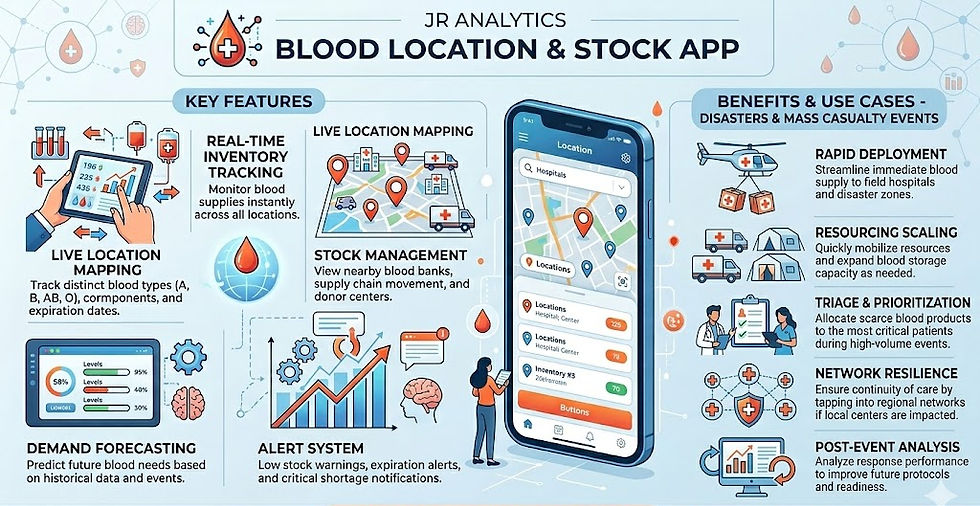
One such tool is Blood Location & Stock, which combines geolocation mapping with real-time operational dashboards to provide a comprehensive view of blood product availability across hospitals and regions. Users can visualise nearby sites on a live map, access site-specific inventories, and review stock levels across key products including RBC, plasma, platelets, and cryoprecipitate.
Beyond static inventory tracking, the platform incorporates dynamic metrics such as days to empty, product utilisation, and transfer planning, enabling clinicians and transfusion services to anticipate shortages rather than react to them. This supports prioritisation of near-expiry units, reduces wastage, and facilitates timely redistribution between hospitals.
The inclusion of scenario modelling tools such as mass casualty or disaster setting allows services to simulate demand, adjust transfer policies, and generate coordinated response plans across multiple sites.
By integrating mapping, real-time data, and predictive planning, Blood Location & Stock enables a shift from fragmented inventory awareness to a connected, system-wide approach to blood management, strengthening preparedness for routine care as well as large-scale emergencies.
Conclusion
In conclusion, enhancing blood availability during emergencies is vital for improving patient outcomes. By leveraging digital tools and fostering collaboration among healthcare providers, we can create a more efficient and responsive system. The integration of technology will not only streamline processes but also ensure that we are better prepared for future challenges.
References
TC Alfred to become the first system to cross NSW, south-east Queensland in 50 years
Lifeblood calls for blood donations after distribution disrupted by ex-Tropical Cyclone Alfred. The Courier-Mail.https://www.couriermail.com.au/news/toowoomba/lifeblood-calls-for-blood-donations-after-distribution-was-interrupted-by-extropical-cyclone-alfred/news-story/d731a8ee3e36bef87102767a55453a5c ↩


Comments